Solar Specific Yield & Performance Calculator
This free online solar specific yield calculator helps you assess how efficiently your solar plant is performing by calculating three key metrics: Daily Specific Yield (kWh/kWp/day), Reference Yield (Peak Sun hours/day), and the Performance Target Index (PTI range 0-1.5).
Steps to Use Our Free Solar Performance Metrics Tool
- Enter Energy Generated: Provide the total energy produced in kilowatt-hours (kWh) for the analysis period.
- Enter Plant DC Capacity: Input the installed DC capacity of the plant in kilowatts (kWp).
- Insolation POA: Add the measured plane-of-array insolation (sunlight received) in kWh/m² during the same time period.
- Anticipated PR (%): Provide the expected performance ratio for your plant. This typically ranges between 65%–85%.
- Number of Days: Insert the total number of days over which the energy generation and insolation data were recorded.
-
Irradiance @ STC: Standard test condition
irradiance, by default sets to
1 kW/m²by this calculator. -
Submit the form to calculate:
- Daily Specific Yield The amount of energy generated per kilowatt per day of installed capacity over the number of days specified.
- Reference Yield Equivalent peak sun hours per day based on total solar irradiation over a specified period.
- Performance Target Index: PTI typically ranges from 0 (poor performance) to 1.5 (unrealistically high performance).
- PTI between 0.8 and 1.2 → Normal / expected performance
- PTI below 0.8 → Underperformance (losses or data mismatch)
- PTI above 1.2 → Overperformance or unrealistic inputs
PTI values significantly above 1.2 are often caused by optimistic PR assumptions, incorrect irradiation periods, or data quality issues.
These metrics enable clearer performance benchmarking, early issue detection, and optimization of solar energy systems over time.
Understanding Solar Specific Yield
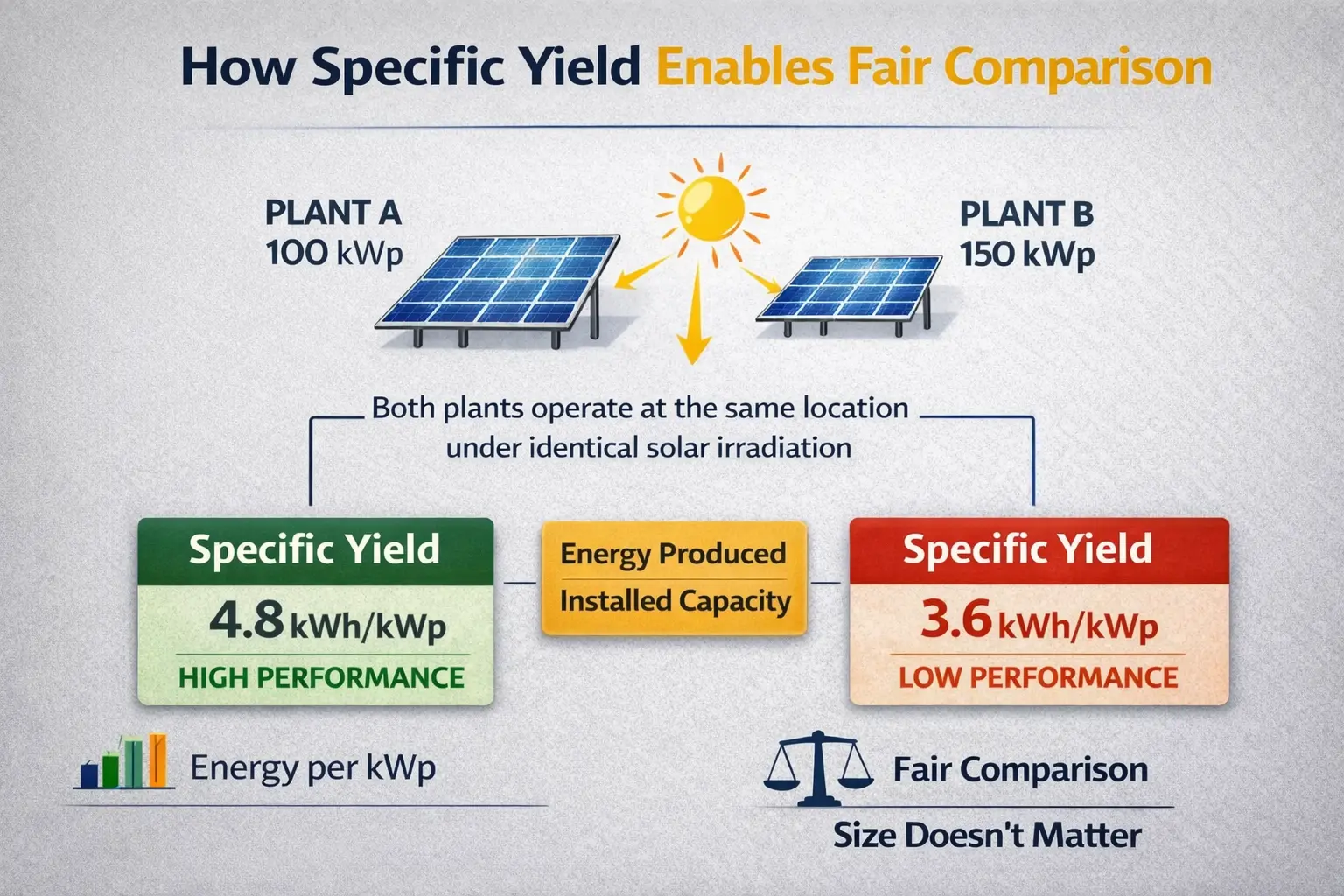
Solar Specific Yield means how much energy a plant produces per unit of installed capacity. It is a standard performance metric used to compare solar plants of different sizes.
Solar Specific Yield is calculated using the formula:
Specific Yield = Total Energy Generation (kWh) ÷ Installed Capacity (kWp)
The unit of Specific Yield is kWh/kWp
What Solar Specific Yield Indicates
Specific Yield reflects the quality of the solar site and the overall system design. It depends mainly on solar irradiation, temperature, orientation, and system losses. It does not represent solar panel efficiency or energy conversion efficiency.
Specific Yield vs. Specific Yield Per Day
While they sound similar, they serve different roles in solar O&M:
- Specific Yield (kWh/kWp): Used for long‑term financial reporting (Monthly, Annual). It tells you how much value the asset generated over a season.
- Specific Yield Per Day (kWh/kWp/day): The energy generated in a single day per unit of installed capacity. It is used as a secondary sanity check to compare the daily performance of solar plants with different capacities installed at the same location, using identical orientation and technology, and operating under similar irradiation conditions on the same day.

👉 Why Specific Yield Is Used in Solar Plant Analytics
A larger solar plant produces more total energy simply because it has more installed capacity but that alone does not indicate better or worse performance.
Specific Yield normalizes energy production by installed capacity. It measures how much energy is produced per kWp at a given site.
This allows fair comparison of solar plants with different capacities installed at the same location and enables evaluation of long-term performance independent of plant size.
What affects specific yield
- Solar irradiation
- Tilt and orientation
- Shading losses
- Temperature losses
- Soiling and cleaning frequency
- Inverter and cable losses
Reference Yield (Peak Sun Hours/Day)
Reference Yield represents Peak Sun Hours/Day. It indicates how many hours the sun would need to shine at standard test condition irradiance to deliver the measured solar energy.
It is calculated by dividing the plane-of-array (POA) insolation by the standard test condition irradiance of 1 kW/m². The result is expressed in hours.
Reference Yield (hours) = POA Insolation (kWh/m²) ÷ 1 kW/m²
ℹ️ Reference Yield reflects available solar resource only. It does not include system losses or plant efficiency.
Performance Target Index (PTI)
Performance Target Index (PTI) is a custom performance indicator used to compare actual plant output against expected output under the same solar conditions.
PTI = (Specific Yield) ÷ (Reference Yield × Expected PR)
PTI is not a standardized IEC or IEC 61724 performance metric. It should be used as a comparative operational KPI, not as a contractual or financial performance guarantee.