Which Solar Performance Ratio Should You Use? Capacity, Efficiency, Instantaneous & Temperature-Corrected PR Compared
I get asked "which PR should I use" more than almost any other question on site visits, and it's usually because someone is comparing two numbers that were never meant to be compared. Capacity-based PR, efficiency-based PR, instantaneous PR, and temperature-corrected PR aren't four versions of the same metric, they answer four different questions about the same plant. Mixing them up is one of the most common reporting mistakes I see, including from experienced O&M teams.
Below, I explain what each method measures, when I’d use it, and where it can go wrong.
What Is Performance Ratio (PR) in Solar?
Performance Ratio tells you how much of your plant's theoretical energy output it actually delivered, after every loss is stripped out and accounted for. IEC 61724-1 sets the base formula:
PR (%) = (Final Yield ÷ Reference Yield) × 100
Final Yield is the AC energy your plant delivers per kW of installed capacity, over the period you're measuring. Reference Yield is the energy that same capacity would deliver if every photon converted at STC efficiency with zero losses.
Here's one from a monthly report I pulled recently: a plant delivered 135 kWh per kW of installed capacity for the month. Reference yield for that same period, from measured POA insolation, came out to 165 kWh per kW. Divide the two and PR is 81.8%. That leftover 18.2% is real — temperature, soiling, wiring resistance, inverter conversion, curtailment and figuring out which loss ate how much of it is the actual O&M job. PR alone won't tell you that; it just tells you how big a problem you're chasing.
PR isn't one fixed calculation, though. Four distinct methods, covered below, use different inputs and time resolutions to answer four different engineering questions.
Why Multiple PR Methods Exist
All four methods sit on the same IEC 61724-1 foundation above. What changes is the input data and the time window you calculate over and that comes down to what you're actually trying to find out.
I've sat on both sides of this. Watching an inverter trip in real time on SCADA calls for a different number than the one I give a lender assessing a project's performance, and that's different again from comparing a plant's June output to its December output. The physics on the panel doesn't change between those three situations, only the question changes.
Before Calculating Any PR
Every PR method is only as good as the data feeding it. Before you trust any PR figure, regardless of which method produced it, check the basics:
- Verify POA sensor calibration and tilt alignment against the array.
- Remove nighttime and near-zero irradiance values, which produce unstable ratios.
- Exclude inverter clipping periods if your methodology requires it.
- Filter missing or interpolated SCADA values rather than treating gaps as zero output.
- Validate that energy and irradiance timestamps are aligned to the same interval.
A surprising PR swing is worth checking against the data before you troubleshoot plant equipment. Before you investigate inverters or strings, confirm the underlying irradiance, energy, and temperature data are reliable.
PR Methods Compared
| PR Method | What It Measures | Best Use Case | Required Data | Advantages | Limitations |
|---|---|---|---|---|---|
| Capacity-Based PR | Energy output vs. theoretical energy based on installed DC capacity and measured reference irradiance | Long-term trend tracking, lender/auditor due diligence | AC energy, DC capacity, POA insolation | Standard IEC-aligned reference metric; widely understood | Sensitive to irradiance sensor errors; not temperature-normalized |
| Efficiency-Based PR | Conversion performance relative to physical module area and rated efficiency | Design verification, commissioning, independent engineering assessments | Energy, POA insolation, active module area, rated module efficiency | Ties performance back to physical design parameters | Invalid if mixed module types or unverified area/efficiency data are used |
| Instantaneous PR | Real-time AC power normalized by installed DC capacity and instantaneous POA irradiance | Live SCADA diagnostics, fault detection, commissioning checks | AC power, DC capacity, irradiance (W/m²) at one moment | Immediate visibility into operating issues | Fluctuates with cloud transients and sensor timing offsets; not for contractual reporting |
| Temperature-Corrected PR | PR normalized to 25°C STC conditions | Seasonal benchmarking, contractual performance guarantees | Energy, DC capacity, POA insolation, average module temperature, temperature coefficient | Removes thermal bias for fair month-to-month or season-to-season comparison | Assumes linear temperature behavior; less precise with only average (not interval) temperature data |
Capacity-Based PR
Capacity-based PR compares actual AC energy output against the theoretical energy based on installed DC capacity and measured reference irradiance over a reporting period. It's the closest thing to a default, IEC-aligned PR figure, and it's typically what people mean when they say "PR" without qualification.
Use it for monthly or annual trend tracking, and whenever an external party, a lender, an auditor, an asset owner, wants a standard performance figure without deeper diagnostic context.
→ Full Capacity-Based PR Calculator and Methodology
Efficiency-Based PR
Efficiency-based PR evaluates how much of the available solar energy hitting the module surface is actually converted to electricity, based on net active module area and rated module efficiency rather than nameplate DC capacity. It connects performance directly to the physical array design.
It's most useful during commissioning and design verification, or in independent engineering reviews where component-level assumptions need to be checked. It loses validity quickly on plants with mixed module types or uncertain area data. It's useful for engineering studies, but less common than capacity-based PR for routine operational reporting, most O&M teams won't track it month to month.
→ Full Efficiency-Based PR Calculator and Methodology
Instantaneous PR
Instantaneous PR captures real-time conversion efficiency at a single moment, comparing live AC power to DC capacity, normalized against current irradiance. It's built for diagnostics, not reporting.
SCADA analysts and commissioning engineers use it to spot inverter faults, string issues, or sensor problems as they happen. Because it reacts to cloud transients and brief irradiance spikes, don't use it as a standalone benchmark for long-term performance.
→ Full Instantaneous PR Calculator and Methodology
Temperature-Corrected PR
Temperature-corrected PR adjusts the raw PR figure to account for module temperature deviation from the 25°C STC reference, using the module's power temperature coefficient. It answers: how would this plant have performed at standard temperature?
This is the right method when you compare a plant's performance across seasons, or when a raw PR figure looks artificially low simply because it was a hot month. Many performance guarantees specify temperature-corrected PR as the contractual basis, though the specific contract language should always take precedence over general practice. When you apply temperature correction, use the γPmax value from the specific module datasheet rather than a generic default, the coefficient varies meaningfully across module technologies.
→ Full Temperature-Corrected PR Calculator and Methodology
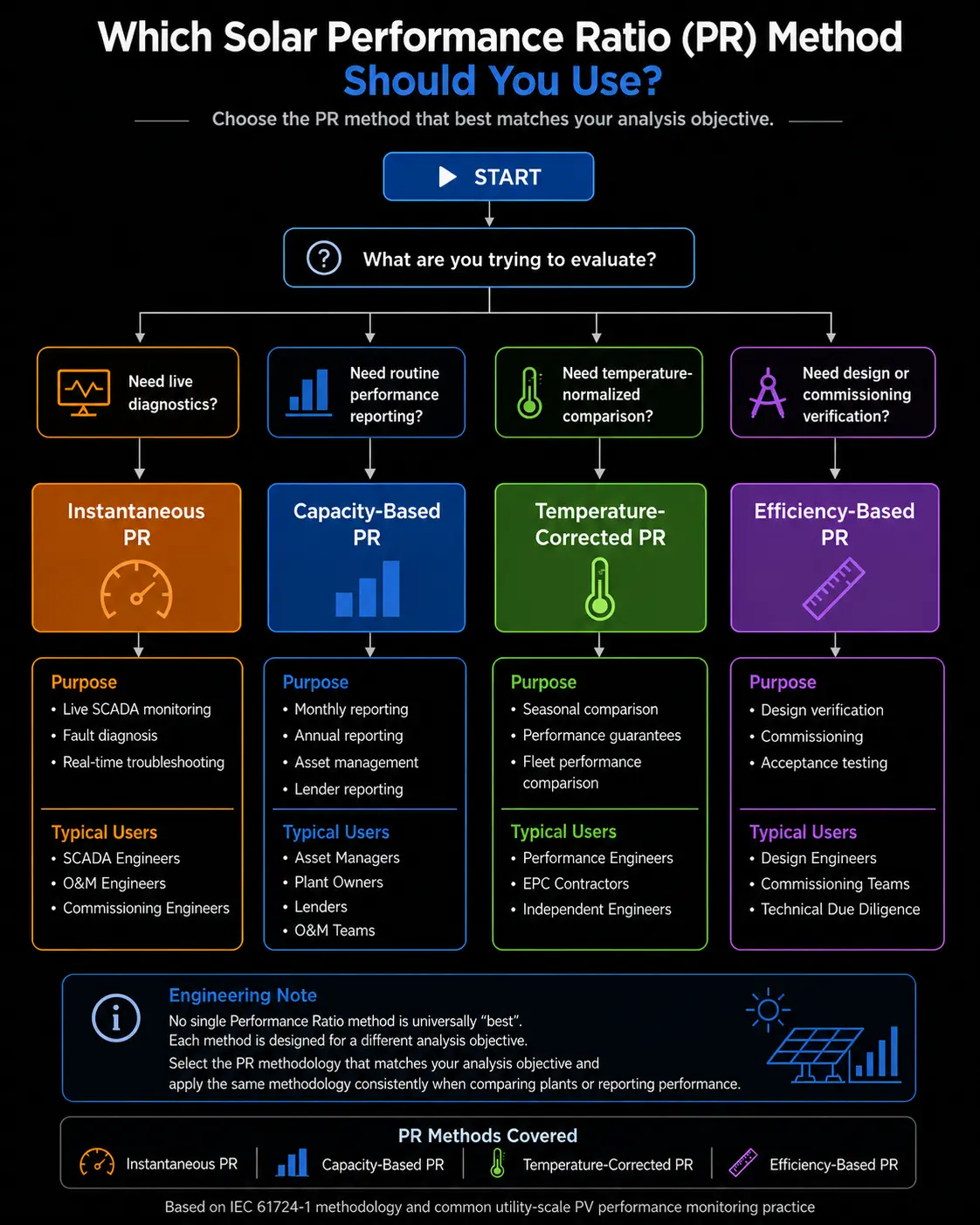
The quickest way to choose the right Performance Ratio method starts with the engineering question you need to answer. The decision guide below summarizes the most appropriate choice for common utility-scale PV analysis tasks.
How to Choose the Right PR Method
Match the method to the question you're actually asking, not to whichever PR figure is easiest to pull from your data:
- Need a live, real-time health check? Use instantaneous PR.
- Reporting a standard monthly or annual KPI? Use capacity-based PR.
- Comparing summer performance to winter performance, or checking a performance guarantee? Use temperature-corrected PR.
- Verifying design assumptions or running commissioning checks tied to module specs? Use efficiency-based PR.
- Comparing PR across a fleet of plants in different climates? Temperature-corrected PR is generally the fairer basis, since raw capacity-based PR penalizes plants in hotter sites for reasons unrelated to system health.
In practice, the decision usually comes down to what's in front of you at the moment:
- An inverter alarm fires at 2 PM. You don't pull up a monthly PR report, you check instantaneous PR against current irradiance.
- A lender asks for a quarterly performance summary. You don't hand them instantaneous PR snapshots, you report capacity-based PR over the period.
- You're comparing a plant in Rajasthan in May against one in Himachal Pradesh in December. Raw PR alone will mislead you here; temperature-corrected PR removes the thermal distortion so the comparison means something.
Common Mistakes Engineers Make With PR
Comparing different PR methods directly
A capacity-based PR of 78% and a temperature-corrected PR of 82% from the same plant aren't contradictory, they're answering different questions. Comparing PR figures across plants or time periods only works if both figures came from the same method.
Ignoring irradiance sensor quality
Every PR method that uses POA insolation is only as reliable as the sensor producing that number. A misaligned or uncalibrated pyranometer can shift PR by several percentage points before any real plant issue is involved.
Using incorrect temperature assumptions
Temperature correction calculated from a single average module temperature value, rather than interval-level data, will understate or overstate the correction during periods of high temperature variability within the day.
Misinterpreting seasonal PR changes
I still get calls in May and June about a "sudden PR drop" that turns out to be nothing but module temperature. Raw PR dips on hot summer afternoons even when every inverter and string is running exactly as designed — the modules alone account for it. Before you write up a seasonal decline as a performance issue, check it against temperature-corrected PR first. Nine times out of ten, that's the whole story.
PR in Context With Other Plant KPIs
PR is one KPI among several, not a standalone verdict. I read it alongside Specific Yield, Plant and Grid Availability, and generation loss analysis to understand why performance moved, not just that it did. A PR drop with stable availability usually points to irradiance or thermal effects. A PR drop alongside falling availability points to downtime or grid curtailment instead. If you're being asked for CUF alongside PR, see my CUF vs. PR breakdown .
Conclusion
There's no single "best" PR. Capacity-based PR is your standard reporting figure. Efficiency-based PR ties performance back to the physical design. Instantaneous PR is for catching problems live. Temperature-corrected PR strips out thermal bias so seasonal and contractual comparisons actually mean something. Match the method to the question you're asking, then run the number in the calculator that fits.
→ Capacity-Based PR · Efficiency-Based PR · Instantaneous PR · Temperature-Corrected PR
Frequently Asked Questions
What is the difference between capacity-based PR and efficiency-based PR?
Capacity-based PR normalizes against installed DC nameplate capacity. Efficiency-based PR normalizes against physical module area and rated module efficiency instead. They can produce different results on the same plant if nameplate capacity and actual physical module specs don't align precisely.
Can I use instantaneous PR for monthly reporting?
No. Instantaneous PR reflects a single moment and fluctuates with short-term irradiance and operating conditions. Monthly or annual reporting should use capacity-based or temperature-corrected PR instead.
Why does my PR look lower in summer?
Higher module temperatures reduce power output below the 25°C STC reference, which is expected thermal behavior rather than a fault. Temperature-corrected PR removes this effect for a fairer comparison across seasons.
Which PR method should I use for a performance guarantee check?
Many guarantees specify temperature-corrected PR as the basis, but the governing contract language should always take precedence over general practice.
Is a higher PR always better?
Generally yes within realistic limits, but PR values approaching or exceeding the high end of the typical range for a given method often indicate a data or sensor issue rather than genuine overperformance. Such values should be checked before being reported.
What is a good Performance Ratio for a solar plant?
A PR above 80% points to strong performance with losses inside expected limits, typical of a well-maintained utility-scale plant with clean modules and stable grid availability. A PR between 70% and 80% is normal for most commercial plants once you account for temperature, moderate soiling, and inverter losses. A PR below 70% is worth a structured loss investigation. These bands describe capacity-based and temperature-corrected PR; efficiency-based and instantaneous PR are read differently.
Can PR be compared between two different solar plants?
Only carefully, and only using the same PR method for both. Differences in climate, module technology, and DC oversizing can distort a direct comparison even when the calculation method matches.
Why do SCADA PR readings and the monthly PR report not match?
They're usually answering different questions. SCADA typically shows instantaneous PR at a point in time, reacting to short-term irradiance swings and transient conditions. The monthly report is built from capacity-based or temperature-corrected PR aggregated over the full period. A mismatch between the two is expected, not necessarily an error.
About the Author
Aman Yadav — I'm a Solar Plant Performance Engineer with 8+ years in utility-scale O&M, including performance monitoring on a 30 MW ground-mounted plant in Madhya Pradesh. Picking the right PR variant and explaining to a client why two PR numbers from the same plant don't match — comes up in my work more than almost any other metric. I built the four PR calculators referenced in this article around IEC 61724-1, using the same logic I run in my own monthly reports.
Connect with me on LinkedIn · Read my CUF guide · CUF vs. PLF, explained