What Is MPPT? How Maximum Power Point Tracking Works in Solar Systems
By Aman Yadav | · Updated
Maximum Power Point Tracking (MPPT) is the control method built into solar inverters and charge controllers that keeps a PV array running at its most efficient voltage and current combination.
A solar panel's output isn't fixed. It shifts constantly with irradiance, temperature, and shading, and the maximum power point moves along the panel's power curve as conditions change. MPPT continuously adjusts the panel's operating voltage and current to keep it operating at or near that point.

What MPPT Actually Does
Every solar panel has a current-voltage (I-V) curve describing how much current it produces at every possible operating voltage. Multiply current by voltage at each point and you get a power-voltage (P-V) curve, which rises, peaks, then falls. That single peak is the maximum power point (MPP).
Left to itself, a panel operates wherever the connected load happens to put it on that curve, which is rarely the peak. MPPT is the control loop — running inside the inverter's or controller's DC-DC conversion stage — that forces the system to sit at or near the MPP by continuously adjusting its input voltage.
Three things move the MPP around: irradiance changes the height of the curve, temperature shifts the MPP voltage (cooler cells push it higher, hot cells pull it lower), and shading distorts the curve into multiple peaks instead of one. A good MPPT implementation re-checks its position against all three, often several times per second.
MPPT Architecture: Single, Multi-String, and Central
How MPPT gets implemented depends heavily on system size and layout.
Single-MPPT Inverters
A single MPPT channel treats the entire connected array as one electrical unit. This works well when every module shares the same orientation, tilt, and shading profile — the normal case on a simple ground-mount or single-roof-face system.
Multi-MPPT String Inverters
Most commercial inverters, and a growing share of residential ones, ship with two or more independent MPPT channels. Each channel tracks its own string or group of strings separately, so a shaded or mismatched string doesn't drag down an unshaded one. On rooftops this usually separates east- and west-facing sections; on commercial and utility-scale sites, it typically separates strings by table row, orientation, or a known shading source such as a tree line or substation structure.
Central Inverters and Combiner-Level Tracking
Large utility-scale plants using central inverters usually perform MPPT for a group of strings rather than for each individual string. This reduces equipment cost but provides less control over individual strings than a multi-MPPT string inverter. As a result, string mismatch caused by shading, soiling, cable faults, connector issues, or degraded modules cannot usually be corrected individually by the inverter and is instead identified through SCADA monitoring, string current measurements, or periodic I-V curve testing.
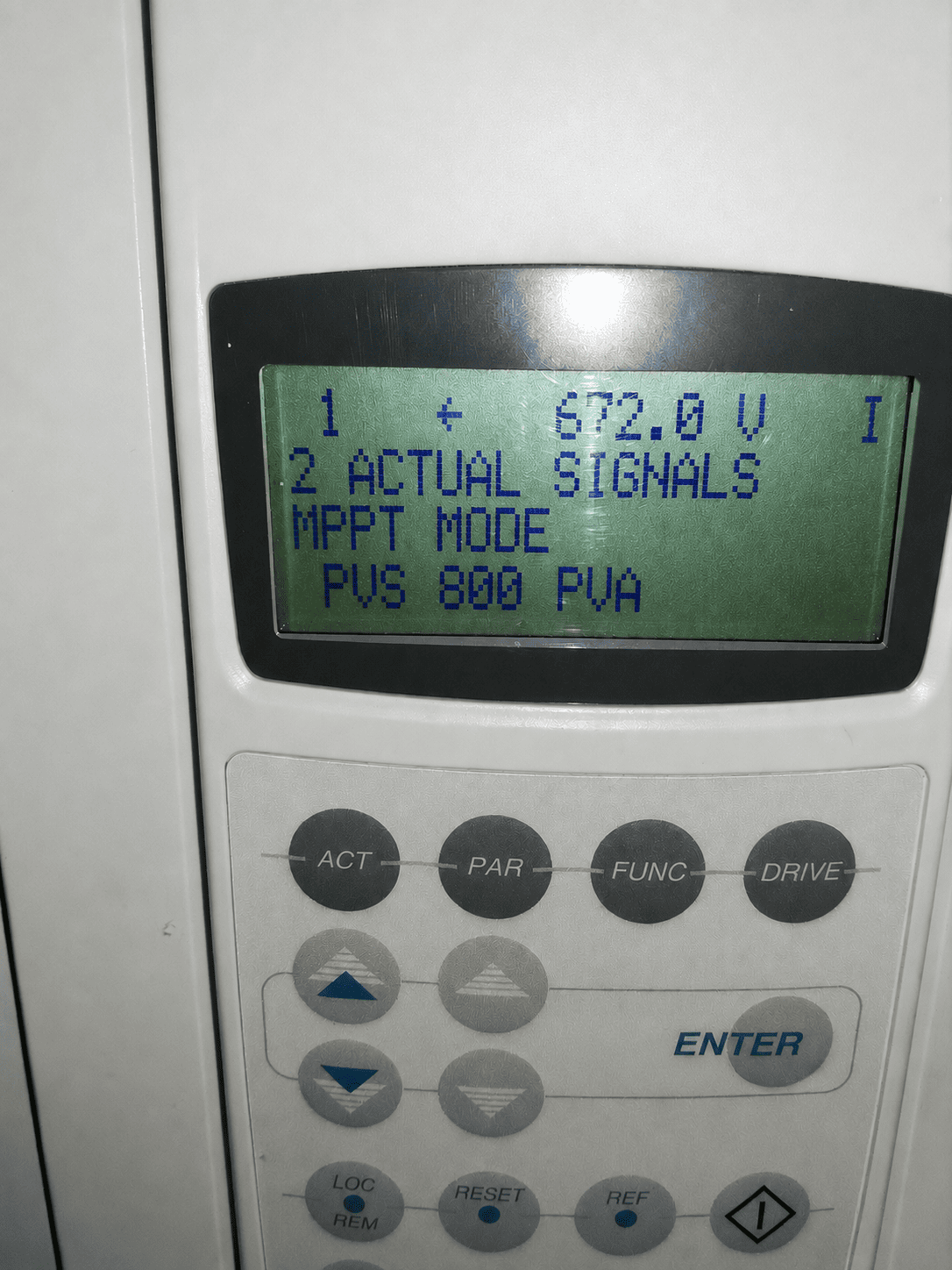
MPPT in Charge Controllers
Off-grid and battery-based systems use a charge controller instead of a grid-tied inverter. The physics is identical, but the target is different: instead of matching grid voltage, the controller has to match a battery bank's voltage, which usually runs far lower than the panel's optimal operating voltage.
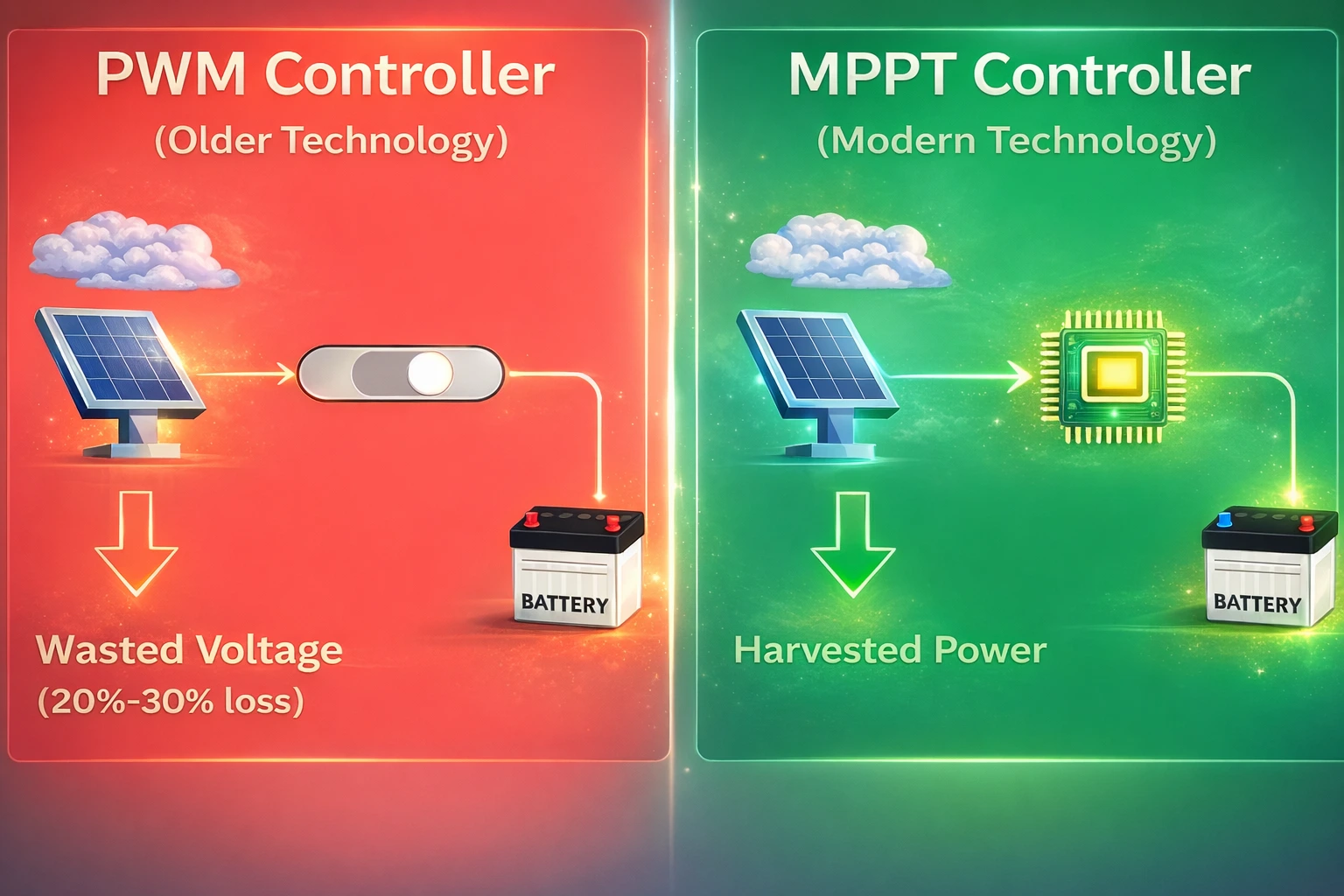
A PWM controller handles that mismatch by clamping the panel down to battery voltage and wasting the excess. An MPPT controller runs a DC-DC conversion stage instead: it draws power from the panel at its actual MPP voltage, then steps that voltage down to battery voltage while stepping current up to conserve total wattage. That current boost is what lets an MPPT controller charge a battery faster than a PWM controller under the same panel conditions — especially in cold weather, when panel voltage runs above its standard-test-condition rating.
MPPT vs PWM
MPPT controllers typically track within about 99% of the true maximum power point. PWM controllers don't track at all — they clamp the panel to battery voltage — so their real-world utilization of available panel power depends entirely on how close panel voltage happens to sit to battery voltage, and commonly lands around 70-80%.
| Feature | PWM | MPPT |
|---|---|---|
| Tracking method | None — clamps panel voltage to battery voltage | Continuously tracks the MPP, ~99% tracking efficiency |
| Typical real-world utilization | Usually 70-80% of available panel power | Typically 90-99% of available panel power, depending on conditions |
| Cold-weather behavior | Excess voltage is wasted, not converted | Higher panel voltage converts into more current |
| Partial shading | Full string output drops to the shaded module's level | Can recover most of the array's power via global MPP tracking |
| Relative cost | Lower upfront cost | Higher upfront cost, typically offset by higher yield over time |
The gap between the two widens in cold and variably-shaded conditions, because that's when panel voltage runs furthest from battery or grid voltage — exactly the scenario PWM handles worst and MPPT is designed for.
Partial Shading and Bypass Diodes
Shading is where the difference between MPPT and PWM shows up most, and it's also the most commonly misunderstood part of MPPT technology.
When part of a string is heavily shaded, those cells produce much less current and can become reverse biased, causing them to dissipate power instead of generating it. Modules include bypass diodes across groups of cells to prevent excessive heating (hotspots) by allowing current to flow around the shaded section. When a bypass diode conducts, the string's power-voltage curve develops multiple local peaks instead of one smooth maximum.
A basic controller, or a weak MPPT algorithm, can settle on the first peak it finds instead of the true global maximum. Many advanced MPPT implementations periodically perform a global scan to check whether a higher power point exists elsewhere on the curve, particularly under partial shading. This is one of the key differences between basic and advanced MPPT designs, and not every controller performs it equally well.
One clarification worth making explicitly: bypass diode activation happens automatically, from the module's own electrical behavior. The MPPT doesn't detect or trigger it. What the MPPT controls is what happens next — whether the tracking algorithm finds the true global maximum among the resulting peaks, or gets stuck on a smaller one.
MPPT Tracking Algorithms
The algorithm running inside a controller affects how well it responds to fast-changing conditions like passing clouds or moving shade.
| Algorithm | How it works | Trade-off |
|---|---|---|
| Perturb & Observe (P&O) | Nudges voltage a small step, checks whether power went up or down, repeats in that direction | Simple and cheap, but oscillates around the MPP instead of settling exactly on it, costing a small amount of energy continuously |
| Incremental Conductance | Compares instantaneous conductance to its rate of change to calculate the MPP directly rather than hunting for it | More accurate and faster under rapidly changing irradiance, but needs more processing power and tighter sensor accuracy |
| Fractional Open-Circuit Voltage | Estimates the MPP as a fixed percentage of the panel's open-circuit voltage | Simple and inexpensive, but it's an approximation that doesn't respond well to rapid temperature changes, partial shading, or module aging like P&O or Incremental Conductance. |
| Hybrid / adaptive methods | Combine two or more of the above, switching strategy based on how fast conditions are changing | Better all-round performance, at the cost of firmware complexity most small controllers don't need |
MPPT's Real Impact on CUF and PR
MPPT operates on a timescale of milliseconds to seconds. CUF and PR are measured over months and years. That gap matters more than it sounds.
A well-designed MPPT keeps the PV array operating close to its maximum power point, maximizing energy extraction under changing operating conditions. This can contribute to a small but measurable improvement in PR under variable irradiance—particularly on cloudy or partially shaded days, where a weak implementation might otherwise settle on a local maximum. You can spot-check this day to day using instantaneous PR. But MPPT can't touch the loss categories that actually dominate long-term CUF: inverter clipping from an undersized DC/AC ratio, temperature losses in hot climates, module degradation, soiling, and grid or equipment downtime.
To separate the contribution of MPPT from other loss mechanisms, compare CUF / PLF calculator results with a temperature-corrected PR analysis. This helps distinguish tracking performance from losses caused by temperature, clipping, soiling, degradation, and plant availability.
Why MPPT Can't Fix Poor CUF or PR Alone
It's a common instinct on site visits: if PR is low, check the inverter's MPPT efficiency spec, see it's rated near 99%, and move on to the next suspect. That's usually the wrong move.
MPPT operates at the inverter or charge-controller level. CUF and PR are system-wide figures that capture everything from module temperature to cable losses to grid availability. Inverter clipping from an undersized DC/AC ratio alone can cost more annual energy than any realistic MPPT efficiency gap ever will. So can high module temperatures in summer, or a hotspot-driven string derate that has nothing to do with tracking.
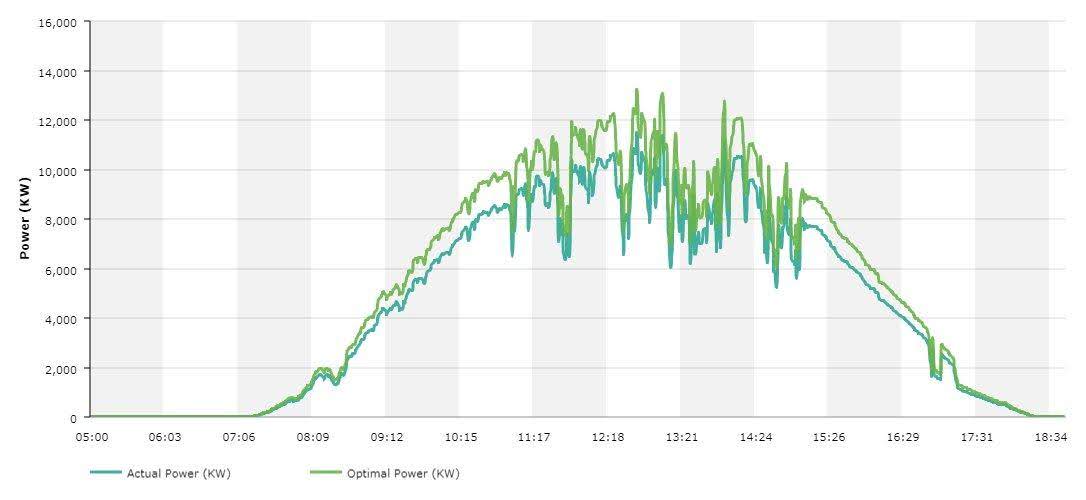
Before crediting or blaming MPPT for a PR shift, correct for temperature and irradiance first, then isolate degradation using a degradation and insolation-corrected CUF calculation. What's left after that is a far more honest picture of what MPPT tracking is actually contributing.
Common MPPT Problems and What They Mean
MPPT voltage stuck near open-circuit voltage
Often indicates the controller cannot establish its normal operating point. Common causes include a tripped output breaker, a disconnected battery, a grid-side fault preventing export, a failed string fuse, very low irradiance during startup, or another condition that prevents normal power transfer.
Power output far below the sum of expected string output
On a multi-MPPT inverter, check each channel's reported power individually before assuming an array-wide fault. A single underperforming string usually points to shading, a loose connector, or one degraded module dragging that string's curve down.
Tracking efficiency reads near 99% but PR is still low
The inverter is doing its job. Look elsewhere — temperature, soiling, clipping, or degradation. Our inverter efficiency dashboard is a quick way to confirm the inverter itself isn't the bottleneck before chasing other causes.
Frequent MPPT re-hunting on a clear, stable day
Rapid, repeated voltage hunting under stable irradiance often points to a loose DC connection or an aging capacitor in the converter stage rather than a genuine tracking problem. Worth an I-V curve trace if it persists.
Is MPPT Worth It for Home Systems?
For any grid-tied home system, yes — nearly every residential grid-tied inverter sold today ships with MPPT built in, so the question rarely comes up in practice. For small off-grid setups, such as a single panel trickle-charging a 12V battery, a PWM controller is cheaper and the tracking gain may not justify the extra cost. Above roughly 100W, or anywhere panel voltage runs meaningfully higher than battery voltage, MPPT earns its keep.
Pros and Cons of MPPT Technology
The Pros ✅
- Recovers 15-30% more energy than PWM under typical real-world conditions.
- Handles cold weather better, since panel voltage running high gets converted into current instead of wasted.
- Recovers more power under partial shading by tracking the global maximum.
- Supports higher-voltage system designs, which can allow thinner DC wiring.
The Cons ❌
- Higher upfront cost than PWM.
- More complex power electronics, which means more that can fail.
- Not worth the premium on very small, unshaded, single-panel setups.
Frequently Asked Questions
What does MPPT stand for?
Maximum Power Point Tracking — the control method solar inverters and charge controllers use to keep a PV array operating at its most efficient voltage and current point.
Is MPPT better than PWM?
For any system above roughly 100W, or wherever panel voltage runs higher than battery voltage, yes. MPPT typically tracks within about 99% of the true maximum power point, versus 70-80% real-world utilization for PWM, which clamps voltage rather than converting it.
Does MPPT work in the shade?
It helps, but it doesn't eliminate shading losses. When bypass diodes activate on a shaded string, the power curve develops multiple peaks, and MPPT's job is to find the global maximum among them instead of settling on a smaller local peak — that recovers power a basic controller would lose entirely.
What is the difference between single and multi-MPPT inverters?
A single-MPPT inverter tracks the whole array as one unit, which works when every module shares the same orientation and shading. Multi-MPPT inverters track separate strings independently, so one shaded or mismatched string doesn't pull down the rest of the array.
Does MPPT improve CUF and PR?
MPPT can improve instantaneous power extraction and may produce a modest improvement in PR under variable irradiance or partial shading. However, long-term CUF and PR are influenced far more by temperature, soiling, degradation, clipping, availability, and system design.