Degradation & Insolation Corrected CUF: Formula and Worked Example
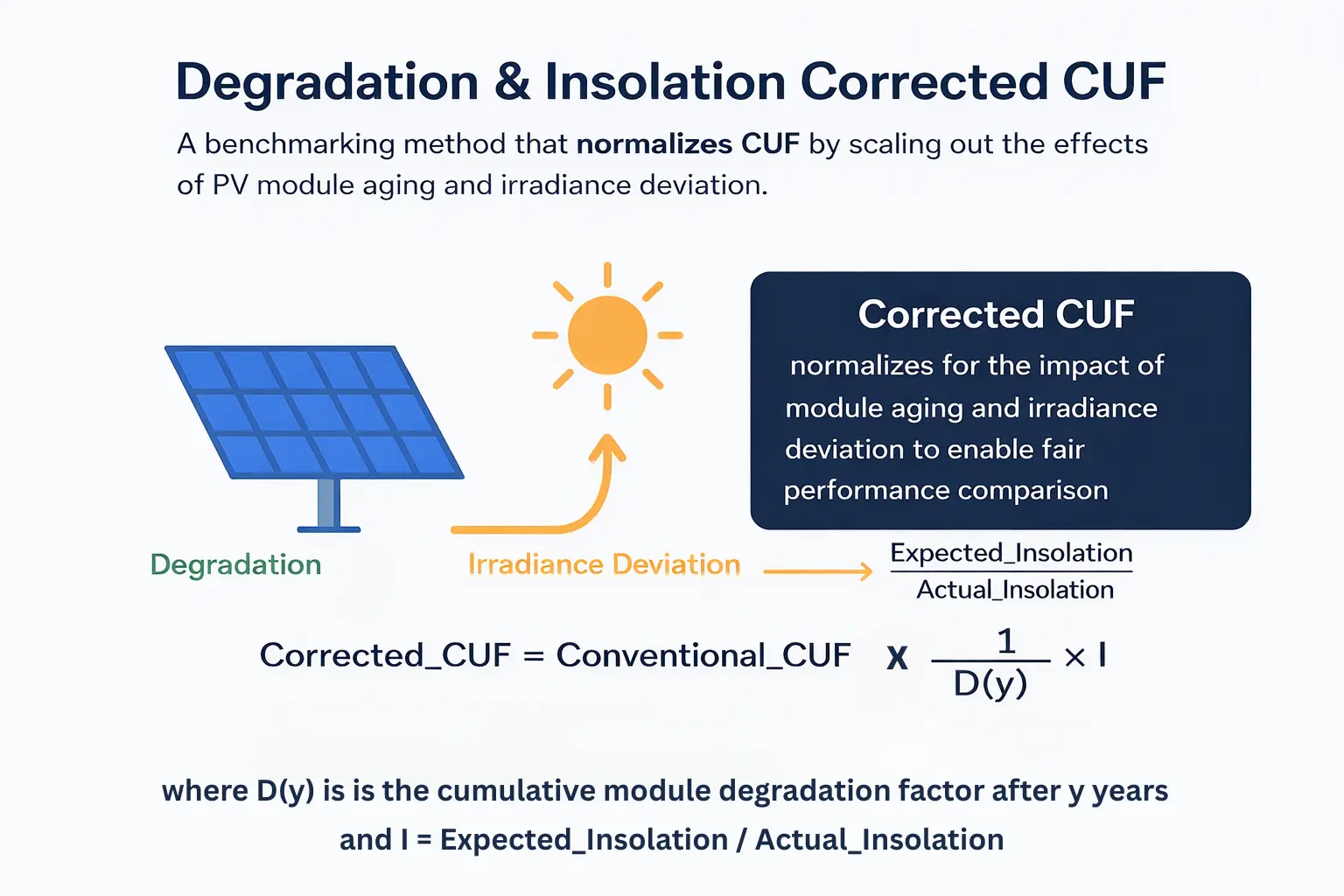
Degradation & Insolation Corrected CUF adjusts the conventional CUF to represent the plant’s capacity utilization as if the PV modules were operating at their rated, non-degraded capacity and under expected solar irradiance conditions.
A simple and practical method to analyze operational solar performance by normalizing for module aging and irradiance variability, allowing fair comparison across months, years, and locations without altering other physical loss mechanisms.
A five-year-old plant in a below-average irradiance year will show a lower CUF than a new plant in a high-irradiance year, even when both are operating at design efficiency. Degradation & Insolation Corrected CUF removes both variables so the comparison reflects operating performance, not plant age and weather.
What Is Degradation & Insolation Corrected CUF?
Conventional Capacity Utilization Factor (CUF) is the ratio of actual energy generated to the theoretical maximum (rated capacity × hours) during a period. Corrected CUF scales this value to normalize for (1) module degradation and (2) deviation between actual and expected insolation, producing a baseline for performance comparisons across time and locations.
Degradation & Insolation Corrected CUF Formula (Practical Form)
Conventional_CUF = Energy_actual / (P_rated × Hours)
Degradation factor at age y: D(y) = (1 − d)y
where d = annual degradation rate (e.g., 0.8% = 0.008)
Insolation correction factor (POA): I = Expected_Insolation / Actual_Insolation
Corrected_CUF = Conventional_CUF × (1 / D(y)) × I
This formulation assumes a constant annual degradation rate. First-year degradation is intentionally smoothed into the annual rate to avoid discontinuities in long-term benchmarking. Use the same assumption consistently across comparisons.
Important clarification: Measured energy already includes the impact of module degradation. This correction mathematically removes aging effects only for normalization. It does not change actual energy or losses. The goal is fair comparison, not performance inflation.
Data Quality Requirements
Corrected CUF is only as reliable as the irradiance data behind it. Soiled or misaligned POA sensors under-report actual irradiance, which artificially inflates the correction factor and overstates corrected CUF. Validate sensor cleanliness and calibration before trusting a period-over-period comparison, and treat a sudden jump in corrected CUF as a data-quality flag before treating it as an operational win.
When to Use Corrected CUF vs Conventional CUF
Use conventional CUF for PPA compliance and contractual reporting — it's the raw, auditable figure counterparties expect. Use corrected CUF for internal O&M reviews, degradation tracking, and cross-site comparisons, where weather and plant age would otherwise distort the result. The two aren't interchangeable: reporting corrected CUF in a contractual context can make performance look better than the agreed baseline.
Limitations and cautions
- Corrected CUF removes weather and age effects but does not remove curtailment or grid outages unless excluded explicitly.
- It depends on the quality of insolation data.
- Degradation assumptions matter: wrong assumptions will bias comparisons.
- Use contract values (e.g., PPA) for compliance, not corrected CUF.
- Temperature-related losses are not normalized. Seasonal temperature effects remain part of operational performance. Corrected CUF should not be expected to align with temperature-corrected PR.
Methodology and Assumptions
This corrected CUF methodology is intended for performance benchmarking and internal analysis. It assumes a constant annual module degradation rate, reliable plane-of-array irradiance data (measured or well-validated), and consistent capacity definitions across the analysis period. This metric does not replace contractual performance indicators such as PPA CUF, PR guarantees, or availability clauses.
Results should be interpreted as a relative benchmarking metric rather than an absolute performance guarantee.
This methodology assumes DC rated capacity unless explicitly stated otherwise. Do not mix AC energy with DC capacity. Use consistent definitions across all periods.
Conventional CUF vs Corrected CUF
Conventional CUF and corrected CUF answer different questions and shouldn't be substituted for each other — use conventional CUF for contracts and corrected CUF for internal benchmarking.
| Point | Conventional CUF | Corrected CUF |
|---|---|---|
| What it shows | Raw output | Normalized for weather and aging |
| Good for | PPA compliance | O&M benchmarking |
| Low sun | Drops strongly | Adjusted baseline |
| Degradation | Reduces CUF | Neutralized |
| Users | EPCs, investors | O&M teams, auditors |
The table above is a quick reference — see When to Use Corrected CUF vs Conventional CUF for the full reasoning.
Worked Example — annual
These realistic values can be used in the calculator.
| Input | Value |
|---|---|
| Energy (year) | 1,680,000 kWh |
| Plant capacity | 1,000 kW |
| Hours | 8,760 h (365days) |
| Age | 4 years |
| Degradation (d) | 0.8% |
| Expected insolation | 2,000 kWh/m² |
| Actual insolation | 1,900 kWh/m² |
Step-by-step
- Conventional CUF = 19.18%
- D(4) ≈ 0.968
- I ≈ 1.0526
- Corrected CUF ≈ 20.85%
Corrected CUF ≈ 20.9% under the stated degradation and insolation assumptions. Use this value for fair relative benchmarking.
Typical PV Module Degradation Rates
PV degradation varies with module technology, materials, climate, installation conditions, and the degradation mechanism being measured. Field studies commonly report long-term degradation rates below about 1% per year, but individual modules and systems can differ substantially. For performance analysis, use the module manufacturer's warranted degradation rate or measured site-specific degradation rate when available.
Common Mistakes When Calculating Corrected CUF
- Using GHI (Global Horizontal Irradiance) instead of POA (Plane of Array).
- Inconsistent handling of first-year versus long-term module degradation.
- Mixing different insolation datasets without conversion
- Using AC energy with DC capacity.
- Not excluding curtailment or grid outages before calculating CUF.
Fix these for accurate corrected CUF.
Best Practices for Using Corrected CUF
- Be consistent with periods : Compare month-to-month or year-to-year, not a mix.
- Track soiling & downtime : Degradation & Insolation Corrected CUF doesn’t excuse controllable losses—use it to flag them.
- Keep degradation realistic : Typical values often range ~0.5%–1%/year; use your module’s warranted rate if known.
- Use reliable insolation data : Site sensors (POA) preferred.
- Use same comparison period.
- Document degradation assumptions.
- Match AC/DC correctly.
Frequently Asked Questions
What is the formula for degradation and insolation corrected CUF?
Corrected CUF = Conventional CUF × (1 ÷ Degradation Factor) × (Expected Insolation ÷ Actual Insolation), where Degradation Factor = (1 − annual degradation rate)plant age in years.
Should insolation correction use GHI or POA irradiance?
Use plane-of-array (POA) irradiance, not GHI. GHI ignores tilt and orientation, so mixing it with POA-based energy yield introduces a systematic error into the correction.
What degradation rate should I use if the manufacturer doesn't specify one?
Use a site-measured, multi-year degradation rate if you have 3+ years of clean production data; otherwise 0.5–0.7%/year is a reasonable default for current-generation mono-PERC modules.
Does corrected CUF replace Performance Ratio?
No. Corrected CUF only normalizes for aging and irradiance; PR additionally normalizes for temperature and measures actual output against the reference yield expected from the same irradiance — it quantifies system losses, not conversion efficiency. Use PR to assess how close the plant runs to its reference output, and corrected CUF to compare capacity utilization.
Ready to compute? Open the Free Calculator