What is Plane of Array (POA) Irradiance — And How is it Different from GHI?
If you work in solar operations or plant performance analysis, you have seen both terms — POA irradiance and GHI — used in monitoring dashboards, performance reports, and energy yield models. They measure related things, but they are not interchangeable. Using the wrong one in a performance ratio calculation, for instance, will give you a completely wrong result.
This article explains what plane of array (POA) irradiance is, how global horizontal irradiance (GHI) differs from it, and why the distinction matters practically for solar plant engineers and asset managers.
What is Solar Irradiance? (A Quick Grounding)
Solar irradiance is the power of solar radiation incident on a surface, measured in watts per square metre (W/m²). When you integrate irradiance over time, you get irradiation — measured in kWh/m² or Wh/m². You will also see this called insolation, particularly in resource assessment literature and older datasets. The two terms describe the same quantity; IEC 61724-1 and most modern O&M standards use "irradiation" as the technically precise term.
Before getting into POA and GHI specifically, it helps to understand the three base components that solar measurement builds on:
- GHI (Global Horizontal Irradiance) — total solar radiation on a horizontal surface
- DNI (Direct Normal Irradiance) — solar radiation coming directly from the sun's disc, measured perpendicular to the sun's rays. DNI is typically measured using a pyrheliometer mounted on a solar tracker that continuously follows the sun's position
- DHI (Diffuse Horizontal Irradiance) — scattered solar radiation from the sky dome, excluding the direct beam
These three are fundamental solar resource parameters. Most meteorological datasets — including NREL's NSRDB and NASA POWER — provide data in these three components.
What is Plane of Array (POA) Irradiance?
Plane of array irradiance, often abbreviated as POA or sometimes called Global Tilted Irradiance (GTI), is the total solar radiation incident on the actual surface of your PV panels — at their specific tilt angle and azimuth orientation.
Unlike GHI, which is always measured on a flat horizontal surface, POA irradiance accounts for the real geometry of your solar array. It changes based on:
- The tilt angle of your panels
- The azimuth (compass direction the panels face)
- Whether the array is fixed-tilt or on a single-axis tracker
- The position of the sun at any given moment
POA irradiance has three sub-components, as defined by the PVPMC modelling guide maintained by Sandia National Laboratories:
- POA beam component (Eb) — direct solar radiation from the sun hitting the panel surface, adjusted for the angle of incidence
- POA sky-diffuse component (Ed) — diffuse radiation from the sky dome as seen from the tilted plane
- POA ground-reflected component (Eg) — radiation reflected from the ground in front of the panels, which depends on ground albedo
The total POA is the sum of all three:
POA = Eb + Ed + Eg
If you need to estimate POA irradiation but don't have dedicated sensors at your plant, use our free Solar Insolation (POA) Calculator — it back-calculates POA irradiation from your actual generation data, capacity, module efficiency, and performance ratio.
What is GHI (Global Horizontal Irradiance)?
GHI is the total solar radiation received on a perfectly horizontal surface at ground level. It combines the direct and diffuse components through the following relationship:
GHI = DNI × cos(solar zenith angle) + DHI
GHI is measured with a horizontally mounted pyranometer. It does not account for panel tilt or azimuth — it simply measures what hits a flat surface pointing straight up at the sky.
GHI is the standard metric for:
- Solar resource assessments and site feasibility studies
- Long-term energy yield models as input data
- Comparing locations by their solar resource potential
Datasets from Solcast, NREL, and Meteonorm all deliver GHI as a primary output, precisely because it is a standardised, location-specific measurement that does not depend on system configuration.
POA vs GHI: The Core Difference
Here is the simplest way to think about it:
GHI answers: How much solar energy falls on the ground at this location?
POA irradiance answers: How much solar energy actually hits my panels, given how they are oriented?
For a horizontal array (tilt = 0°), POA equals GHI by definition in most transposition models, as the ground-reflected component becomes geometrically zero (the tilted surface no longer "sees" the ground). But the moment you tilt your panels — which is the case for virtually every fixed-tilt and tracker-based utility-scale plant — POA diverges meaningfully from GHI.
A south-facing array tilted at 20° in India will receive more irradiance than GHI for much of the year, because the tilt angles the panels more directly toward the sun's path. During summer months, when the sun is at a high elevation angle, GHI can actually exceed POA for a steep-tilt array, because the sun's rays strike the tilted surface at a higher angle of incidence (reducing the beam component) and the tilted panel's view of the sky dome is reduced. This is why the GHI-to-POA ratio is not a fixed number — it varies with season, tilt, azimuth, and site latitude.
The pvlib community documentation captures this well: the difference between GHI and POA depends on the tilt angle, solar position, and location, which means it varies throughout the day and year.
Why POA Irradiance Matters for Solar Plant Performance Analysis
This is where the distinction has real operational weight.
1. Performance Ratio Calculation Requires POA Irradiation
The IEC 61724-1 standard for PV system performance monitoring defines Performance Ratio (PR) using POA irradiation in the denominator:
PR = Measured AC energy output (kWh) ÷ [Installed capacity (kWp) × POA irradiation (kWh/m²) ÷ 1000 (kW/m²)]
The denominator uses POA irradiation (energy, kWh/m²) — not GHI, and not instantaneous POA irradiance. Dividing by the reference irradiance of 1 kW/m² gives you equivalent peak sun hours on the array plane, which is the correct reference for how much energy the plant should theoretically produce. If you substitute GHI for POA irradiation in this formula, your PR value will be wrong, and comparisons between plants with different tilt configurations become meaningless.
Want to calculate PR correctly for your plant? Our Capacity Based Performance Ratio Calculator uses POA irradiation as the input — the way IEC 61724-1 intends.
2. POA is the Primary Driver of PV Module Output (Along with Temperature)
The physics is straightforward. A PV module generates current in proportion to the irradiance on its cell surface. However, output power is strongly temperature-dependent—typically decreasing 0.35–0.45% per °C above 25°C due to voltage reduction. This is why performance models—PVsyst, SAM, pvlib—all use POA irradiance and cell temperature as primary inputs for module output calculation, not GHI alone.
In operational analysis, it is critical to account for both factors. Two days with identical POA irradiation can show significantly different energy output if module operating temperatures differ — a common situation when comparing winter and summer performance, or morning versus afternoon generation patterns.
Hukseflux, a leading manufacturer of solar radiation sensors, states in their monitoring guidance that POA measurements are preferred for performance monitoring because they measure the actual irradiance incident on the PV panel surface.
3. Monitoring Alarms and Loss Analysis Depend on POA Accuracy
When you configure underperformance alerts on a SCADA or monitoring platform, the reference energy — what the plant should produce given current weather — is calculated from POA. If your POA sensor is misaligned, dirty, or malfunctioning, every alarm threshold is based on a wrong reference.
For string-level fault detection and soiling analysis specifically, accurate real-time POA data is critical. A 2–3% error in your POA measurement can mask real degradation or trigger false alarms on healthy strings.
How is POA Irradiance Measured at a Solar Plant?
Two approaches are standard in practice.
Direct Measurement
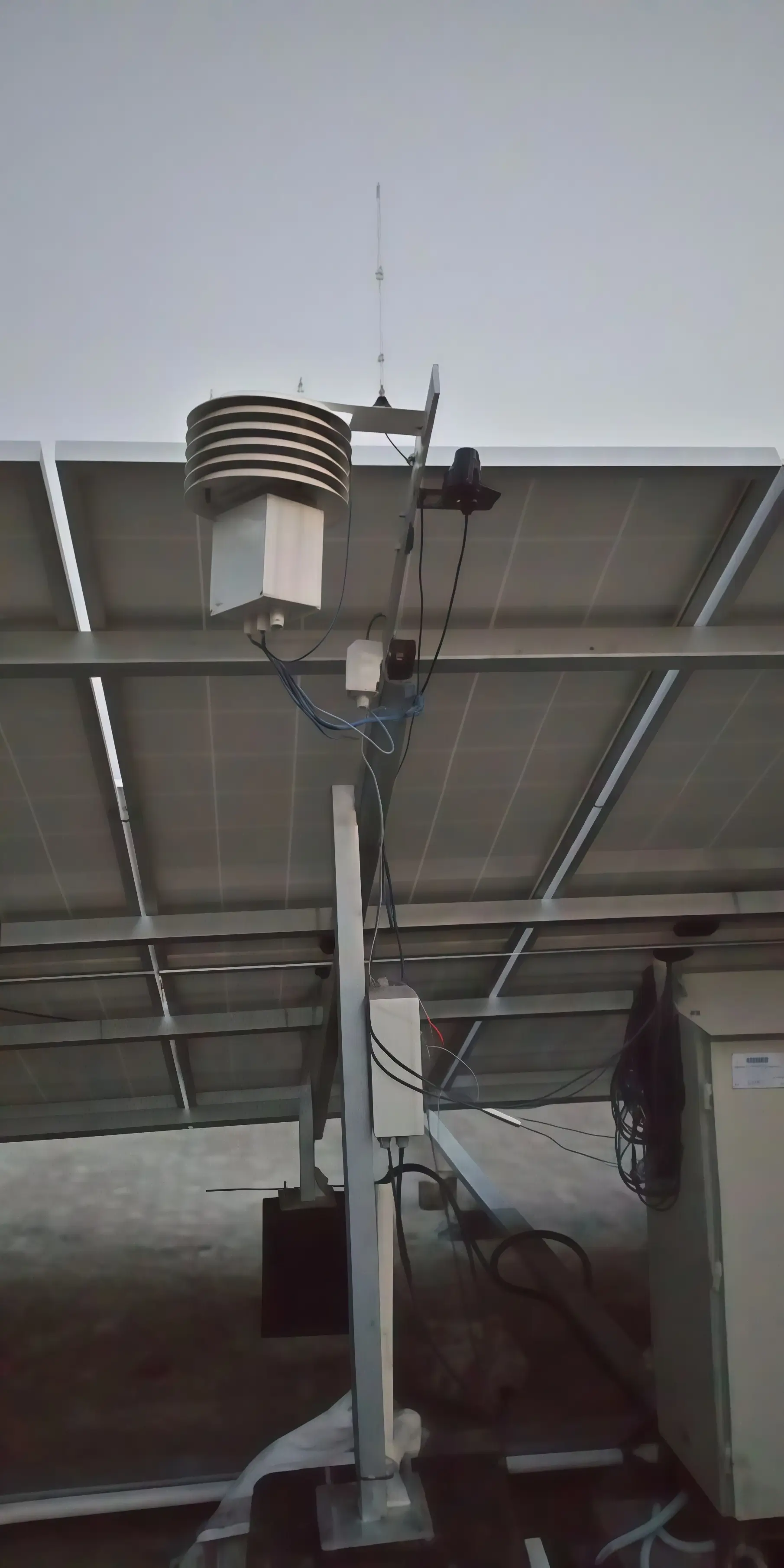
A pyranometer or PV reference cell is mounted at the same tilt and azimuth as the array. It directly measures the irradiance hitting the panel surface. According to IEC 61724-1 (2021 second edition), Class A monitoring systems require ISO 9060:2018 Class A pyranometers for both GHI and POA measurement, with heating and ventilation to prevent dew and frost from affecting readings.
PV reference cells — silicon-based sensors — are also widely used because they share the same spectral response as the modules, which reduces spectral mismatch errors in the irradiance measurement.
Important operational consideration: In real-world plant monitoring, sensor maintenance practices can introduce significant errors. POA sensors are typically cleaned regularly (weekly or bi-weekly), while modules may go weeks or months between cleaning. This creates a soiling mismatch — the sensor reads higher irradiance than what actually reaches soiled module surfaces. A clean sensor measuring 1000 W/m² might correspond to only 950–980 W/m² on soiled modules, leading to artificially low calculated PR values. This is one of the most common sources of PR disputes between plant operators and O&M contractors.
Transposition from GHI
When a dedicated POA pyranometer is not available, POA can be calculated from measured GHI, DNI, and DHI using transposition models. The most commonly used ones are:
- Perez model — more accurate, especially under partly cloudy skies; separates sky diffuse into circumsolar, horizon brightening, and isotropic components
- Hay-Davies model — good balance of accuracy and simplicity; accounts for circumsolar and isotropic diffuse
- Isotropic model — simplest; assumes uniform diffuse radiation from the entire sky dome
A 2015 study published in IEEE Journal of Photovoltaics by Lave, Hayes, Pohl, and Hansen, which evaluated model combinations across multiple US climates, found that the Perez transposition model generally performed best when DNI measurements were available. When working with GHI and DHI only (without direct DNI measurement), combinations using the Hay-Davies model with decomposition models like DISC showed good performance with lower computational complexity.
The transposition approach introduces some modelling error — which is why IEC 61724-1 Class A monitoring specifies direct POA measurement for high-accuracy plant performance assessments.
A Practical Example: Fixed-Tilt Plant in Central India
Consider a 10 MWp fixed-tilt plant in Madhya Pradesh, tilted at 20° south-facing. Annual GHI at the site is typically around 1,750 kWh/m²/year. The plane of array irradiation for that configuration will generally be 5–10% higher — around 1,850–1,900 kWh/m²/year — because the 20° tilt angles the panels more directly toward the sun during the high-irradiance winter and shoulder seasons.
If the performance monitoring system uses GHI instead of POA irradiation in the PR formula, the calculated PR appears inflated by roughly the same percentage. This masks real losses and makes the plant look better than it actually is in reports. Any performance metric that compares actual output to irradiation-based expectations will be similarly distorted if GHI is used instead of POA.
For a single-axis tracker plant in central India (roughly 22–25°N latitude), annual POA irradiation gains over GHI typically range from 10–18%, with site-specific values occasionally falling outside this range depending on ground coverage ratio (GCR), backtracking strategy, and diffuse fraction. The tracker continuously reduces the angle of incidence throughout the day, which is the primary source of the gain. Sites at lower latitudes or with higher diffuse radiation fractions tend toward the lower end of the range.
What is GTI? Is it the Same as POA?
Yes. Global Tilted Irradiance (GTI) is the same physical quantity as POA irradiance. GTI is the term used more often in European contexts and by data providers like Solcast and PVGIS, while POA is the term used in IEC standards and US-centric PV performance modelling tools such as PVsyst, SAM, and pvlib. Both terms refer to the total irradiance on a tilted surface at a defined orientation.
POA Irradiance vs GHI: Summary
| Parameter | GHI | POA Irradiance |
|---|---|---|
| Surface orientation | Always horizontal | Matches array tilt and azimuth |
| Explicitly models ground-reflected radiation based on tilt | No | Yes (albedo component Eg) |
| Use in PR calculation | No | Yes — required by IEC 61724-1 |
| Varies with panel orientation | No | Yes |
| Alternate name | — | GTI (Global Tilted Irradiance) |
| How measured | Horizontal pyranometer | Tilted pyranometer or PV reference cell |
Understanding the difference between POA irradiance and GHI is not an academic exercise. It affects every performance ratio calculation, every underperformance investigation, and every energy yield model you run on an operating solar plant. Getting this right is one of the foundations of credible solar performance analysis.
Frequently Asked Questions
Why is POA irradiance used instead of GHI in performance ratio calculations?
Because PR measures how well a plant performs relative to its expected output under actual irradiation conditions. The "available sunlight" for a tilted array is POA irradiation, not GHI. Using GHI would introduce a tilt and orientation-dependent error that makes PR values incomparable across sites with different array configurations. PR quantifies losses from all sources (temperature, soiling, inverter efficiency, etc.) relative to the energy that should theoretically be produced given the actual POA irradiation received.
What is POA irradiance in solar plant monitoring?
POA irradiance is the total solar radiation incident on the surface of your PV panels at their actual tilt angle and azimuth orientation. It is the primary irradiance input used in performance ratio calculations and energy yield modelling because it reflects the irradiance the panels actually see, not just what hits the ground.
Can POA irradiance be lower than GHI?
Yes. For steeply tilted arrays during summer, when the sun reaches a high elevation angle, the sun's rays strike the tilted panel surface at a high angle of incidence, which reduces the effective beam irradiance received. In such cases, POA can be lower than GHI. This is more common at high latitudes or for vertical/near-vertical bifacial installations
What is the difference between POA irradiance and GHI?
GHI (Global Horizontal Irradiance) measures total solar radiation on a horizontal surface and does not depend on panel orientation. POA irradiance measures the total solar radiation actually incident on the tilted surface of PV panels, accounting for their specific tilt, azimuth, and tracking configuration. POA explicitly models a ground-reflected (albedo) component based on array tilt, which is not captured in horizontal irradiance measurements.
What is the role of albedo in POA irradiance?
Ground-reflected radiation (the albedo component) is one of three sub-components of POA irradiance. For standard monofacial systems on bare soil with a typical albedo of about 0.2, it contributes roughly 1–3% of total POA. For bifacial modules, rear-side irradiance gain from ground reflection becomes much more significant and is often modeled separately to calculate bifacial gain factors.
Does a single-axis tracker have a fixed POA value?
No. For a tracking array, the panel orientation changes continuously as the tracker follows the sun. POA irradiance is calculated at each timestamp using the instantaneous tracker angle, which is why tracker backtracking algorithms matter — they optimize the trade-off between row-to-row shading and angle-of-incidence losses.
Sources and Further Reading
- PVPMC, Sandia National Laboratories — Plane of Array (POA) Irradiance Modelling Guide
- IEC 61724-1:2021 — Photovoltaic system performance — Part 1: Monitoring
- ISO 9060:2018 — Solar energy — Specification and classification of instruments for measuring hemispherical solar and direct solar radiation
- Lave, M., Hayes, W., Pohl, A., Hansen, C.W. — "Evaluation of Global Horizontal Irradiance to Plane-of-Array Irradiance Models at Locations Across the United States", IEEE Journal of Photovoltaics, vol. 5, no. 2, 2015
- Hukseflux — Solar Power Monitoring: How to Calculate PV Performance Ratio
- pvlib community — pvlib Python Documentation
- Solcast — Historical Solar Irradiance Data (GHI, DNI, DHI, GTI)