Japan's Floating Solar Power Plant at Yamakura Dam: A Typhoon, an Investigation, and What It Means for PR and CUF
By Aman Yadav | ·
Japan's best-known floating solar plant isn't famous only because of its size. It's also known for what happened during a 2019 typhoon, when the plant suffered a major failure. A government investigation found that the shape and layout of the floating array played a key role in what went wrong.
That incident is far more useful than a generic list of ‘advantages and challenges’ for anyone evaluating floating PV in a storm-exposed region.

Why Japan Built the World's Largest Floating Solar Plant
Japan has limited flat land relative to its population and industrial base, and a meaningful share of what land exists is protected agricultural ground or otherwise difficult to acquire for a utility-scale array. After the 2011 Fukushima disaster, the government moved to accelerate renewable energy and introduced a feed-in tariff in 2012. The policy made solar projects financially attractive, but Japan soon faced a basic problem: there was not enough easily available land to support the rapid growth of solar development.
Reservoirs changed that calculation. Many water bodies, including irrigation reservoirs, industrial water-supply reservoirs, and flood-control basins, were already under public or utility ownership. Using these surfaces avoided some of the land-acquisition disputes and permitting delays that can arise when developing solar projects on private or agricultural land.
The Yamakura Dam Plant: Scale and Design
The clearest example is the plant built on the Yamakura Dam reservoir in Ichihara City, Chiba Prefecture — a reservoir managed by Chiba Prefecture's Public Enterprises Agency and used for industrial water supply. Kyocera TCL Solar, a joint venture between Kyocera and the leasing company then known as Century Tokyo Leasing, now Tokyo Century, started operating the plant in March 2018. It used roughly 50,900 modules supplied by Kyocera, mounted on Hydrelio floating platforms designed by the French company Ciel & Terre, covering close to 18 hectares of the reservoir surface. At 13.7 MW, it was, at the time, the largest floating solar installation in the world. The power generated was sold to TEPCO Energy Partner.
The plant's size is what makes its later history useful to anyone outside Japan. It was large enough that when the plant suffered a major failure, the investigation that followed identified specific engineering problems rather than leaving behind just an isolated incident.
September 2019: Typhoon Faxai and the Failure Sequence
On September 9, 2019, Typhoon Faxai made landfall near Chiba as one of the strongest storms to hit the greater Tokyo region in decades. Average wind speed during the storm was around 41 m/s, with gusts reported up to roughly 57.5 m/s (about 207 km/h) at the nearby weather station.
The storm versus the design standard
Japan's structural design code for PV mounting systems, JIS C 8955, specified a minimum sustained design wind speed of 38 m/s for that region. Faxai's average wind speed of 41 m/s already exceeded that value, even before accounting for gusts. This wasn't simply a storm that exposed a gap in the code. It directly exceeded the wind speed used as the design basis.
The failure sequence
The floating structure was held in place by 420 anchors connected through 823 mooring lines. According to Japan's Ministry of Economy, Trade and Industry (METI), which investigated the incident and issued its final report in April 2020, the failure progressed as a chain reaction:
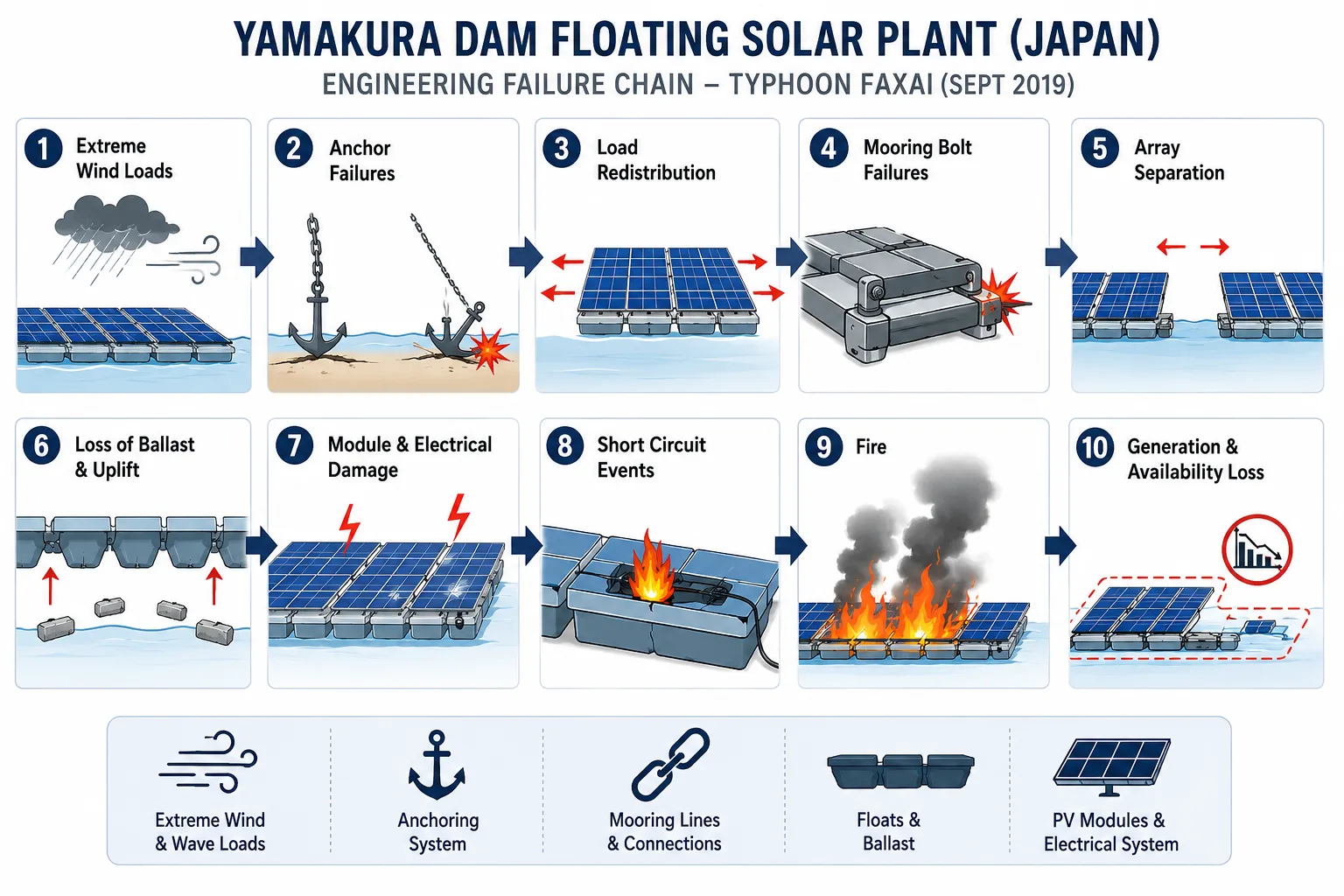
- Typhoon winds put heavy loads on the floating structure.
- Seven anchors in the southern-central section of the structure failed.
- The load carried by those anchors shifted to nearby resin bolts.
- As more bolts failed, the load on the remaining bolts increased.
- The floating structure broke into three separate sections.
- Sections along the outer edge facing the wind lost the ballast that had been counteracting wind uplift.
- Without the ballast, the floats and modules began to lift and curl.
- This movement brought electrical components that were normally separated into contact.
- The contact caused a short circuit, which started a fire involving an estimated 50 panels.
- About two-thirds of the plant was damaged or destroyed, leading to a 16-month rebuild.
Source for the failure sequence: pv magazine's reconstruction coverage, citing METI's investigation and Ciel & Terre; wind-speed and fire-extent figures are corroborated by pv magazine's original incident report and Xinhua's contemporaneous coverage.
What METI's Investigation Actually Found
METI's finding, as reported by Ciel & Terre and pv magazine: the investigation identified the size and shape of the original floating island, the resulting stress concentration, and the safety factors in its design as the main causes of the failure. It did not identify a fundamental flaw in the Hydrelio floating-platform technology itself. Ciel & Terre also stated that its follow-up inspections found no evidence that material degradation over time caused the failure.
The original Yamakura plant was built as one large, complex floating structure. Its shape created higher structural stress in some areas than a smaller, simpler design would have.
Kindastuff's engineering interpretation, not a METI finding: for anyone evaluating floating PV outside Japan, the useful lesson isn't simply that typhoons are dangerous. It is that the size and layout of the floating structure, along with the mooring safety margins, need careful engineering. A design that looks adequate under normal conditions can still have weaknesses when exposed to a storm at or above its design wind speed.
This incident does not show that floating solar is unworkable in typhoon-prone regions. The plant was rebuilt and remains in service. It shows which parts of the original design needed to change.
The Rebuild: Smaller Islands, Different Geometry
Reconstruction took about 16 months and was completed in early 2021. According to pv magazine's coverage of the rebuild, a Ciel & Terre spokesperson said the original single floating island was replaced with several smaller, square-shaped islands to reduce stress concentration. The new design also used higher safety factors. The key engineering lesson from Yamakura is that breaking one large, complex floating structure into several smaller sections can reduce the structural loads created by the original design. That is more useful than simply saying to "use stronger anchors" because it addresses the design issue identified in the investigation.
What This Means for PR and CUF Analysis
The cooling benefit is real, but it isn't fixed
Floating modules generally run cooler than ground-mounted modules because they are close to the water, and lower module temperature does improve conversion efficiency. But the size of this benefit varies widely across published studies. A 2023 literature review in EPJ Photovoltaics examined published studies and vendor claims about the thermal benefits of floating PV. It found reported energy-yield gains ranging from 0.11% to 31.29%, depending on the study and its assumptions. The authors concluded that the effect was "poorly quantified" and that its underlying cause remained unclear across the industry.
| Source | Reported result | Key limitation |
|---|---|---|
| Chowdhury et al. (2023), EPJ Photovoltaics — literature review | Energy-yield gains from 0.11% to 31.29% across the reviewed studies | The review covered studies with different methods and conditions, so the range shows the spread in reported results rather than a single expected value. |
| Elminshawy et al. (2024), Energy (Elsevier, vol. 303) — Mediterranean-climate experimental comparison | Module temperature was 7.24°C lower at a 10° tilt angle, which the authors reported as a 16% relative reduction compared with ground-mounted PV. This is a temperature result, not a 16% output or efficiency gain. | The study used one site and climate and a specific mounting angle, so the result may not apply to other climates or mounting arrangements. |
| Benchmarking/simulation study (ScienceDirect, 2025) | 8.46% more annual energy and up to 4.81% higher performance ratio than land-based PV across five sites | The model was validated against Spanish field data, and five sites are too small a sample to support a general result for all locations. |
The overall pattern is clear even though the reported numbers vary widely. Floating PV can have a thermal advantage, but the size of that advantage depends on factors such as water depth, mounting height, local climate, wind exposure, and module type. There is no single "floating solar adds X% output" figure that applies to every site. Any fixed percentage should be treated with caution unless it is supported by data from a comparable site.
This is where temperature-corrected PR can help at the plant level. It helps separate the effect of module temperature from changes caused by other factors, such as irradiance, electrical losses, and availability. This makes it easier to determine whether a PR improvement actually comes from lower operating temperatures rather than from factors that would have affected the plant anyway.
Availability and generation loss from a structural event
The Yamakura incident is also a reminder that a floating plant's biggest performance risk isn't always related to temperature. Structural damage and downtime can have a much larger impact. Losing two-thirds of the plant's capacity, followed by a 16-month rebuild, was a major availability event and caused significant generation loss. Neither impact would be captured by an analysis focused only on temperature and cooling. For floating solar plants in storm-prone areas, monitoring availability during the storm season is just as important as measuring the gains from lower module temperatures.
Degradation and Long-Term Monitoring
The points below are general floating-PV O&M considerations, not findings from the Yamakura investigation itself. Public reporting on the incident does not link the failure to long-term degradation; the failure was sudden and structural rather than a gradual performance decline.
Floating installations can be exposed to higher humidity than nearby ground-mounted plants, which makes it important to monitor connector corrosion, declining insulation resistance, and grounding problems over time. These issues can develop gradually, while short-term PR trends may remain stable until the effects become noticeable. Tracking degradation- and insolation-corrected CUF across multiple seasons, rather than relying only on raw CUF or a single year of PR data, can help detect gradual performance losses before they become larger and harder to diagnose.
What Developers Elsewhere Should Take From This
The Yamakura Dam case doesn't argue against floating solar in storm-prone regions. Japan rebuilt the plant, and it remains in operation. Instead, it shows why the size and layout of the floating structure, anchoring safety margins, and wind-load assumptions need careful engineering rather than being treated as standard design details. It also shows why claimed performance benefit, whether from cooling or other factors, should be verified using corrected PR and CUF data instead of being assumed simply because the plant is floating.
For a look at how a different failure mode plays out on a ground-mounted plant, including specific fault codes and field photographs from an actual site, see this inverter cooling failure case study.
Sources
Sources are listed in order of importance to the claims made in this article. A primary METI investigation report was not publicly available in English. The closest available source is an industry report covering a METI Working Group meeting where the investigation findings were discussed.
- Industry report on METI's Working Group proceedings: Nikkei Business Publications / Solar Power Plant Business, "Anchors Coming Away Cause Fire at Floating Solar Plant in Chiba" (November 2019) — reports on the October 28, 2019 METI Working Group meeting, where Kyocera TCL Solar presented findings from its investigation.
- Technical reporting: pv magazine, "The weekend read: Don't throw caution to the wind" (February 2020) — source for the JIS C 8955 design wind-speed figure and the anchor and mooring-line counts used in this article.
- Reconstruction coverage and Ciel & Terre statement: pv magazine, "Japan's largest floating PV plant being reconstructed after Typhoon impact" (February 2021) — source for the rebuild timeline, Ciel & Terre's statement about the square-island redesign, and its account of METI's April 2020 findings on island size and shape, stress concentration, and safety factors in the original design.
- Original incident report: pv magazine, "Japan's largest floating PV plant catches fire after Typhoon Faxai impact" (September 2019).
- Independent news report: Xinhua, "Firefighters battle blaze at floating solar plant near Tokyo" (September 2019) — corroborates the plant size, fire extent, and timing.
- Peer-reviewed research on floating-PV cooling: G. Chowdhury et al., "How cool is floating PV? A state-of-the-art review of floating PV's potential gain and computational fluid dynamics modeling to find its root cause," EPJ Photovoltaics (2023); Elminshawy, Osama, Gagliano, Oterkus & Tina, "A technical and economic evaluation of floating photovoltaic systems in the context of the water-energy nexus," Energy (Elsevier, 2024), vol. 303, article 131904; and a five-site benchmarking study published in ScienceDirect (2025). These studies are cited only to show the range of reported floating-PV cooling effects in the broader literature, not as Japan-specific or Yamakura-specific measurements.
Frequently Asked Questions
Did the Yamakura Dam typhoon failure show that floating solar doesn't work in Japan?
No. The plant was rebuilt and remains in operation. METI's investigation attributed the failure to the original floating structure's size, shape, and safety margins, not to a fundamental problem with floating PV technology. The rebuilt plant uses smaller, square-shaped floating structures to address the design issue identified in the investigation.
Does floating solar always improve solar plant performance?
No. Floating PV can run cooler than ground-mounted PV, which can improve output, but the size of the benefit varies widely by site and study. Whether a gain occurs at a particular site, and how much of it comes from lower module temperature, should be measured using temperature-corrected PR rather than assumed simply because the plant is floating.
What caused the fire at the Yamakura plant?
A cascading anchor and mooring-bolt failure. Panels along the wind-facing edge lost their ballast after nearby anchors failed, lifted and curled, and brought electrical components into contact — the resulting short circuit ignited a fire involving an estimated 50 panels.
What changed in the plant's design after the rebuild?
The size and layout of the floating structures. The original single, large, complex-shaped floating structure was replaced with several smaller, square-shaped structures to reduce the stress concentrations identified in the investigation. The rebuilt plant also used higher safety factors in the mooring design.
Disclaimer
This article is written from a solar plant performance and O&M engineering perspective. The author is not based in Japan and was not involved in the Yamakura Dam project. All project and incident details are drawn from the sources listed above; where a detail could not be independently verified, it has been left out rather than estimated.